
Yangzhou, September 10 — At the 2026 Automotive Lightweighting Conference, VAMA and GONVVAMA shared technical insights on Ductibor®1500, a third-generation aluminized hot-formed steel, and the YuJian™ multi-part integration solution, exploring new pathways for the latest hot-formed steels to simultaneously enhance lightweighting and safety performance.
As new energy vehicles continue to advance toward greater lightweighting and higher safety, body structures are placing higher demands on material performance. How to further tap lightweighting potential while meeting safety requirements has become an important direction for innovation in automotive steel technologies. During on-site exchanges on automotive steel technologies at the conference, participants reached a common understanding that “current lightweighting must achieve not only lower weight and higher strength, but also simultaneous improvement across multiple performance dimensions.” For many years, the technological evolution of hot-formed steels has continued to push the boundaries of lightweighting potential. The third-generation aluminized hot-formed steel Ductibor®1500 further combines ultra-high strength, high fracture strain, and high spot-weld strength, offering a new material option for vehicle energy-absorbing zones.
“In the past, crash zones in vehicle bodies often required combinations of high-strength materials and soft zones to balance strength and energy absorption,” said Jin Jiachun, Senior Customer Technical Support at VAMA, citing simulation analyses during on-site discussions. “Ductibor®1500 offers another new option: by combining high strength and high toughness within the material itself, it can meet crash safety requirements while reducing the need for complex part designs.” Simulation results show that, at the same thickness, Ductibor®1500 improves energy absorption by 36% compared with conventional solutions and offers a 15% weight-reduction potential.
Improved material performance has further expanded the application space for Ductibor®1500 across different body regions. For typical energy-absorbing components such as body longitudinal rails, its application can achieve weight reductions of up to 22%. In B-pillar applications, laser welding Ductibor®1500 with Usibor®2000 can deliver a 16% weight reduction.
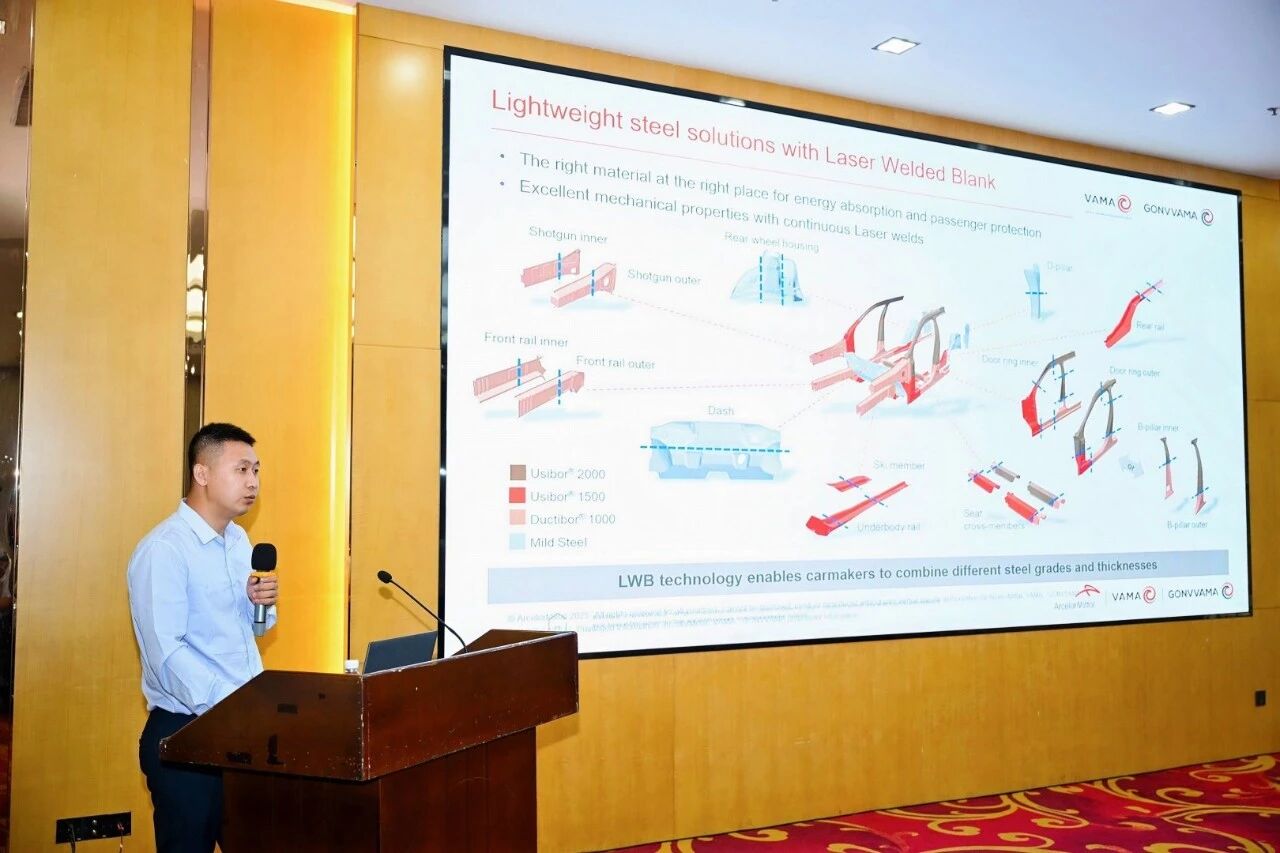
Guo Yunlong of GONVVAMA stated, “The outstanding material properties of Ductibor®1500 and Usibor®2000 provide a solid material foundation for the implementation of the YuJian™ multi-part integration solution, enabling better realization of lightweighting, safety, and cost targets for highly integrated body structures.”
As material performance continues to break through, hot-formed steel applications are extending toward more efficient structural design and integrated manufacturing. Laser-welded blanks can combine different steel grades and thicknesses according to the performance requirements of different body regions, placing the right material in the right location to further unlock lightweighting potential while meeting crash performance requirements.
Building on this, the YuJian™ multi-part integration solution is further advancing body structures toward higher levels of integration. Application cases across multiple upper and lower body structures show that collaborative optimization of hot-formed steels and integration solutions can not only further reduce weight, but also improve manufacturing efficiency, optimize costs, and reduce carbon emissions. This integrated approach aligns with the higher demands for body integration efficiency in new energy vehicles, especially battery electric vehicles. By reducing the number of stamped parts and assembly steps, YuJian™ further converts material performance advantages into comprehensive value at the vehicle manufacturing stage.
From breakthroughs in material performance to innovations in body design and upgrades in manufacturing methods, hot-formed steel is becoming an important technological force driving the coordinated development of automotive lightweighting and safety. As material innovation and multi-part integration applications continue to deepen, hot-formed steels will continue to expand their technical application scenarios, providing new momentum for the industry to explore lighter, safer, and more efficient body solutions.
Source: VAMA
